Juanita Salas vs. Hon. Court of Appeals and Filinvest Finance & Leasing Corporation
G.R. No. 76788. January 22, 1990
181 SCRA 296
Petition for review on certiorari
FACTS: Petitioner bought a motor vehicle from the Violago Motor Sales Corporation evidenced by a promissory note. The note was subsequently endorsed to Filinvest Finance & Leasing Corporation which financed the purchase. Petitioner defaulted in her installments because VMS delivered a different vehicle to her. Due to her failure to pay Filinvest filed a collection suit.
The trial court ordered petitioner to pay the defendant. They both appealed the decision to the Court of Appeals. In her appeal, she did not implead VMS as a party to the case because she already sued VMS for “breach of contract with damages” in another case.
The Court of Appeals modified the decision and ordered the petitioner to pay the defendant sum of P54,908.30 at 14% per annum. Her motion for reconsideration was denied.
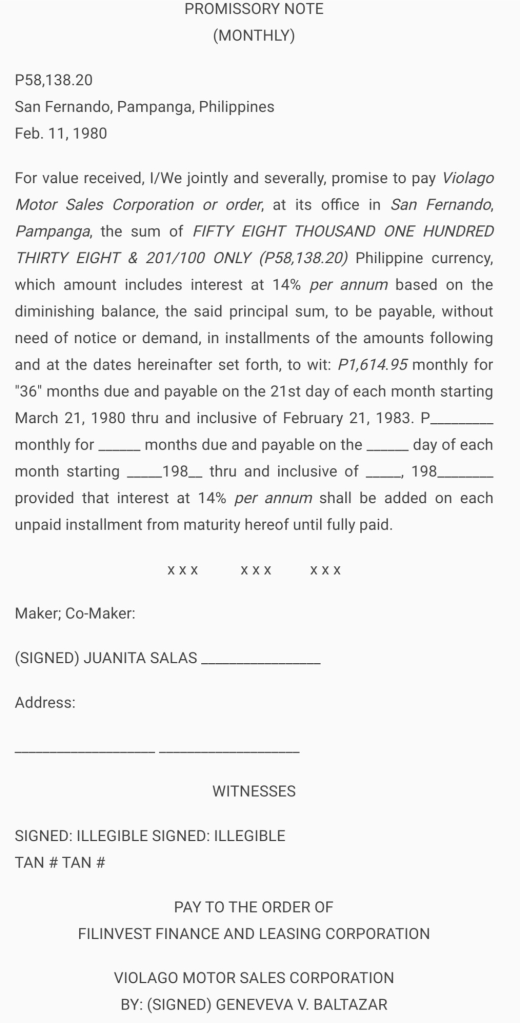
ISSUE: Whether or not the promissory note is a negotiable instrument which will bar completely all the available defenses of the petitioner against private respondent. Her defense is that Filinvest should proceed against VMS because the alleged fraud, bad faith and misrepresentation by VMS supposedly released her from any liability to Filinvest.
RULING: The questioned promissory note is a negotiable instrument because it complied with all the requisites provided for by law:
[a] that it is in writing and signed by the maker Juanita Salas;
[b] that it contains an unconditional promise to pay the amount of P58,138.20;
[c] that it is payable at a fixed or determinable future time which is “P1,614.95 monthly for 36 months due and payable on the 21 st day of each month starting March 21, 1980 thru and inclusive of Feb. 21, 1983;”
[d] that it is payable to Violago Motor Sales Corporation, or order and as such,
[e] that the drawee is named or indicated with certainty.
The note was negotiated by indorsement in writing on the instrument itself payable to the Order of Filinvest Finance and Leasing Corporation. It is an indorsement of the entire instrument.
Filinvest is a holder in due course because it has taken the instrument under the following conditions:
[a] it is complete and regular upon its face;
[b] it became the holder thereof before it was overdue, and without notice that it had previously been dishonored;
[c] it took the same in good faith and for value; and
[d] when it was negotiated to Filinvest, the latter had no notice of any infirmity in the instrument or defect in the title of VMS Corporation.
As a holder in due course, Filinvest holds the instrument free from any defect of title of prior parties, and free from defenses available to prior parties among themselves, and may enforce payment of the instrument for the full amount thereof. This being so, petitioner cannot set up against respondent the defense of nullity of the contract of sale between her and VMS.
NOTES: The instrument in order to be considered negotiable must contain the so-called “words of negotiability — i.e., must be payable to “order” or “bearer”. Under Section 8 of the Negotiable Instruments Law, there are only two ways by which an instrument may be made payable to order. There must always be a specified person named in the instrument and the bill or note is to be paid to the person designated in the instrument or to any person to whom he has indorsed and delivered the same. Without the words “or order or “to the order of”, the instrument is payable only to the person designated therein and is therefore non-negotiable. Any subsequent purchaser thereof will not enjoy the advantages of being a holder of a negotiable instrument, but will merely “step into the shoes” of the person designated in the instrument and will thus be open to all defenses available against the latter.
The instrument is payable to order where it is drawn payable to the order of a specified person or to him or his order. (Consolidated Plywood Industries Inc. vs. IFC Leasing and Acceptance Corporation, 149 SCRA 448)
 Myline Cordial
Leave a comment